


Augusta: Authentic discoveries not to miss
Most people today know Augusta as the site of the Augusta National Golf Course and the Masters—the world’s most prestigious tournament. But the city is far more than that.
--Philip Lee Williams
Story and photos by Hank Segars
Situated 90 miles east of Lake Country via Interstate 20, the city of Augusta and Richmond County received unexpected devastation from an intense September 27 (2024) hurricane named Helene. The toll was awful: damaged homes and buildings, downed power lines and trees, and a city left with major disruptions. Even the famed Augusta National Golf Course received serious damage.
“This storm literally spared no one,” stated Governor Brian Kemp, while surveying the Augusta’s damage. “(It’s) similar to a 250-mile-wide tornado.”

The good news is the historic city is making strides in returning to normalcy as rebuilding takes place and tourist attractions are continuing to reopen. As a tribute to the tenacity of our neighbors to the east, perhaps a time to visit and support Augusta’s local economy is in order. A visit downtown to see the many interesting sites makes a great daytrip.
There is a lot to see in Augusta. Not to be missed are beautiful views of the Savannah River and downtown’s Riverwalk and Canal Discovery Center. The many historic homes and notable museums provide fascinating Georgia history for even the most seasoned of sightseers.
My visit was prior to the arrival of Hurricane Helene and this is a simple guide for making new discoveries within the city’s downtown historic district. When traveling from Lake Country, exit I-20 onto Washington Road and you might want to try Rhinehart’s Oyster Bar. (Rhinehart's locations: https://www.rhineharts.com/two-locations.cfm). And please don’t judge this book by its cover! The seafood is well-worth the stop.
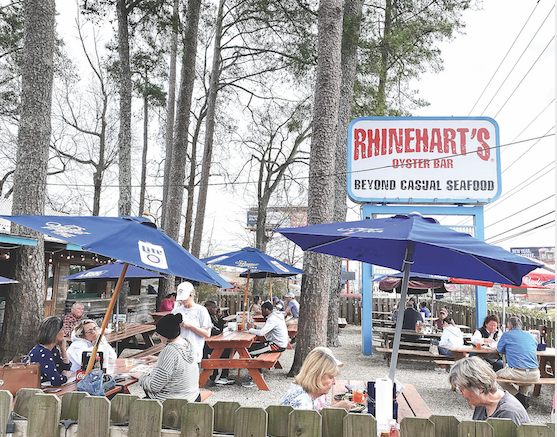
Craig and Amy Rhinehart opened this unpretentious eatery in 1983 with only a small refrigerator and toaster. The unpaved parking lot is packed with vehicles with local tags and several from surrounding counties and the Carolinas. Self-identified as “Beyond Casual,” this is basically a beach shack that still uses paper plates on well-worn tables, and the walls are covered with penned messages by customers.
Aside from the oyster and fish entrees, Rhinehart’s coastal menu includes items not normally found in Lake Country to include bayou shrimp, catfish chowder, jambalaya, fried pickles, crawfish tails, lime butter rice, and po’ boys. Truly an Augusta institution.
****

Traveling past the Augusta National Golf Course, head downtown towards the city’s Riverwalk, located between 6th and 10th streets. The multi-level, pedestrian-only brick walkways offer scenic views of the Savannah River and the large, attractive homes that dot the South Carolina side of the river. Trails lead to Japanese Gardens, a Heroes’ Overlook honoring distinguished veterans and the Jessye Norman Amphitheater. The Augusta Marriott at the Convention Center is only steps away at Tenth Street.

Also, the Discovery Center at Enterprise Mill and the Augusta Canal National Heritage Area ( https://augustacanal.com/) are major attractions. An electric-powered replica of an old-time Pittsburg boat rests outside the center near the historic canal.
“Experience the Augusta Canal in a whole new way!” explains Julianna Shurtleff, Education Programs Director. “In an hour-and-a-half tour, you will discover how the Augusta Canal propelled innovation by using waterpower to usher the city into the Industrial Revolution. An immersive tour explains what it was like to work in a textile mill in the 1800s; plus, the boat ride explains how cotton came to Augusta.”
Civil War buffs will enjoy views of the Confederate Powder Works—an important site for wartime manufacturing (117 Goodrich St., Augusta). And the accompanying canal scenery includes local plants and wildlife, and glimpses of Augusta’s oldest houses. Inside the Discovery Center, an interpretive museum portrays the industrial revolution with interactive exhibits depicting the life and work of millworkers, bringing some of Georgia’s early history to life.
****
The nearby twin spires of Augusta’s magnificent Sacred Heart Cultural Center catch the attention of downtown visitors (1301 Greene St., Augusta). Listed on the National Register of Historic Places, this landmark served as Augusta’s principle Catholic Church in the 1900s. Constructed in Byzantine and Romanesque design, the now decommissioned church is stunning with original statuary and historic stained-glass windows.

Abandoned for 16 years, the church is now painstakingly restored and still has the appearance of a cathedral. Reopened in 1987, Sacred Heart is now fully repurposed and serves as a popular venue for business, cultural, and social activities.
Today, self-guided tours provide opportunities for exploration of the manicured grounds and the building’s beautiful interior, complete with imposing stained-glass windows and ambulatories depicting memorable scenes from the life of Christ.
“Although Sacred Heart is no longer used as a church, it is still a sermon in stone and stained-glass,” notes Edward J. Cashin. “It still imparts a quiet benediction upon the sensibility of its visitors.”
****
Travelers interested in Presidential History will want to see The Boyhood Home of President Woodrow Wilson located at 419 Seventh Street. The young Wilson lived with his family in this home from 1860 to 1870, a place where he resided the longest during his lifetime. After leaving Augusta, the Georgian earned his Ph.D. from John Hopkins University and eventually became president of Princeton University and later elected governor of New Jersey

In 1912, Thomas Woodrow Wilson became the 28th President of the United States and during his second term during World War I, the former Augusta resident played a significant role in negotiating the Treaty of Versailles and in organizing the League of Nations. His historic home is now a restored museum and designated a National Historic Landmark. Best of all, visitors are allowed to enter 14 rooms and

view original pieces of antique furniture as they hear informative presentations about Wilson’s early life in Augusta.
Strongly influenced by his boyhood experiences in this house during the Civil War and Reconstruction, Wilson’s experiences in Augusta are said to have affected him for the rest of his life.
****
The places visited on this brief excursion were inspiring and impressive but, unfortunately, some prominent sites were missed. Nevertheless, I vowed to make a return trip to see other discoveries to include the Augusta Museum of History, Phinizy Swamp Nature Park, and the Morris Museum of Art.
And, of course, any return visit requires an initial stop at Rhinehart’s Oyster Bar. Afterall, a seafood fix at an authentic beach shack is always needed.
~ ~ ~ ~ ~
This article appeared in Lakelife magazine, Volume 18, Issue 6, and is the property of Smith Communications, Inc. No portions of the story or photos may be copied or used without written consent from the publisher.


Comments