


Falkland Islands
Trekking a place of incredible landscape and wildlife
Story and photos by Leigh Lofgren

Traveling to the Falklands was never on my mind until the idea of sitting among penguins, being surrounded by hundreds of albatross nesting with chicks, walking among giant elephant seals and visiting several islands finally caught my attention.

The Falkland Islands lie off the coast of Patagonia and are a remote South Atlantic archipelago and a favorite destination for bird and wildlife enthusiasts. There are five different penguin species – Gentoo, Rockhopper, Magellanic, Macaroni and the King Penguin, elephant seals, sea lions and 80% of the world’s population of Black-browed Albatross. The windswept Falkland Islands are home to huge numbers of sheep and its rugged terrain and cliff-lined coast make them some of the most remote and least densely populated places on earth with around 3,500 residents. There are 775 smaller islands; East Falkland and West Falkland are the two largest. Over the two weeks spent there, we visited five of the islands and flew in very small planes, weather permitting, from island to island. With the exception of The Neck on Saunders Island, most of the inhabited islands are privately owned with one lodge that offers meals and is, for the most part, extremely comfortable and friendly.
Sea Lion Island, the most southern inhabited island, is operated solely for wildlife and

wilderness tourism. In 2017, it was designated as a National Nature Reserve, and in 2021, was voted as one of the seven wonders of the Falkland Islands. With one lodge, this island is an important birding area and a major breeding site for a variety of seabirds and waterbird. Over 56 species of flowering plants grow there, including the Fuegian Violet which is found only on Sea Lion Island. This island is also famous for its marine mammals, and killer whales can be viewed offshore. Its sandy beaches, tussac grass plantations and open plains, make walking easy.
Pebble Island in the northwest of the archipelago
has a varied terrain with rocky peaks andwhite sandy beaches including Elephant Beach, the longest beach in the Falklands at 4-miles long. It has a carefully managed sheep farm and is an important bird area for Black-crowned Night Herons, Imperial Cormorants and the Gentoo, Magellanic and Rockhopper Penguins.

Saunders Island is the second largest offshore island with a varied terrain from rocky hills to sweeping shorelines and one of the most iconic vistas of the Falklands, The Neck. This island is a birder’s paradise with Elephant Seals, all five breeding species of penguins, Black-browed Albatross, Red-backed Hawks, Nosey Striated Caracaras, waterfowl and wading birds. “The Settlement” houses the owners of the island, the Pole-Evans family, who make up the island’s total population of seven and run a sheep farm.
East Falkland Island is the largest of the Falkland Islands and where the capital, Stanley, is situated. Boasting stunning coastlines, hilly mountains, great areas for camping, walking and wildlife watching, it is home to a variety of wildlife and more.

We stayed at the Malvinas Guest Hotel in Stanley and took several day trips, one of which was to Volunteer Point, a protected nature reserve and a populous bird area. Here you will experience the largest King Penguin colony in the islands with up to 1,200 adults and chicks. The site is also a breeding ground for Gentoo and Magellanic Penguins, the Falkland Steamer Duck, Ruddy-headed Geese and Southern Sea Lions. Volunteer Point is accessible only through a local tour guide. Another trip was to Yorke Bay on a peninsula and is connected to the mainland by the Boxer Bridge and a narrow isthmus known as “The Neck”. This bay is a true hidden beauty with white sand, friendly wildlife and many other natural wonders.
West Falkland Island is the second largest of the Falkland Islands with a population of around 200 people. Having a more rugged landscape than East Falkland, it hosts large farms and one of the best places for wilderness sea trout fishing. The Islands offer various penguin colonies, Black-browed Albatross, Elephant Seals and whales, which can often be spotted on boat trips or from the sky. We stayed at the beautiful Port Howard Lodge, located on the largest remaining sheep farm on West Falkland. You will also find a small museum there of the 1982 conflict between England and Argentina.


These two weeks were some of the best times, weather was windy and sometimes cold, accommodations and food were terrific and the people friendly. If you want to visit an incredible archipelago with stunning white beaches, sparking blue and aquamarine seas, untouched landscapes and incredible birds and wildlife, you cannot pass up The Falklands. For me, it was better than expected and I’ll return to visit more of the accessible islands.
Tours with or Artur, Susan and Marianna at Lazy Wind Tours – website: lazy-wind.com are exceptional. They do small group tours, take excellent care of you from arrival to departure and you will not be disappointed.
David Hemmings Photo Tours for all photographers who want to be up close to nature, wildlife and more. Go to hemmingsphototours.com. Most of my trips are with David, who’s the best.
Wildlife and Birds:

King Penguin is the largest breeding penguin in the Falklands, are quite tame and very curious. They have a bright orange ear patch, the largest colony is at Volunteer Point. Incubating adults carry the egg on their feet and can raise two chicks every three years. They do not migrate and remain close to their breeding grounds.
Gentoo Penguins
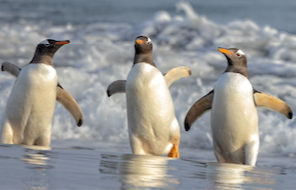
are second in size to the King and remain throughout the year, forming colonies up to a mile inland and then walk the distance to and from the sea. They return to their nesting sites every year and adults are marked with a white horizontal bar across the top of their head with a long orange and black bill. There are over 100 breeding sites across the island.
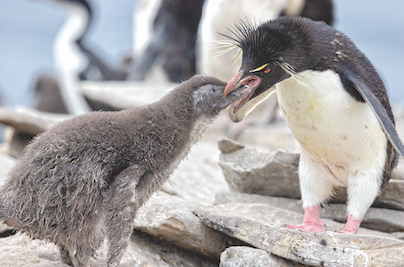
Rockhopper Penguins are the smallest in the Falklands and have low yellow brows that lead to yellow plumes that hang down behind the eyes. They hop with both feet together ascending and descending the steep rocky cliffs to the water below. They arrive in the summer and leave after the molting in April. (pictured above beside "Pebble Island.")
Magellanic Penguins are known locally as Jackass because of their braying call. They are

reserved and will retreat from people. They live in burrows built on coastal cliffs, near tussac, in residual peat or exposed sand.
Macaroni Penguins have a full crown that is bright orange-yellow in color with plumes spreading up and away from the forehead. Single pairs can be seen among the larger colonies of rockhoppers.
Black-browed albatross are endangered and have a pale yellow-pink bill with a black line crossing the top of the eye, hence the black-browed
effect. They will lay a single egg in October and return to the same nest every year.

Falkland Steamer Duck is a flightless duck and one of the only two endemic species of birds in the Falklands. Found among coasts, it feeds on mussels, crayfish and other shellfish.

Imperial Shag can be easily seen as it prefers to feed in open offshore waters and builds its nest on cliff tops, sometimes among rockhopper penguins.

Upland Goose are very tame and have no regard for people or cars. Females have a rust-colored head and orange legs compared to the white head and black legs of the male.
Kelp Goose prefer rocky shores where it feeds on seaweed above the low tide mark. Males are completely white, while the females are dark brown with white barring below.
Ruddy-headed Goose is often seen with the upland goose and both the male and female resemble the female upland goose. They incubate 5-8 eggs in October with the chicks fledging in January or February.

Striated Caracara is a large bird of prey, also known as the Johnny Rook, and are found throughout the islands, but their population numbers are low. Nests are built on cliffs and breeding sites are usually among rockhopper colonies and they feed on small penguins, shags and albatross chicks. They will also take eggs and search for carrion.
Magellanic Oystercatcher prefers sandy or a muddy coastline and can be seen searching rockpools for worms, crabs or other invertebrates. A very striking bird with a white breast contrasting against a slate black upper body with bright yellow eyes and long orange bills.
Falkland Skua is a large mainly brown seabird that nests in colonies on mainland points near to sources of prey such as penguin colonies. They are known for swooping attacks on people or other animals, especially when defending their nest and chicks. They feed mainly on the chicks of other seabirds including shags, penguins and geese and will also take eggs and carrion.


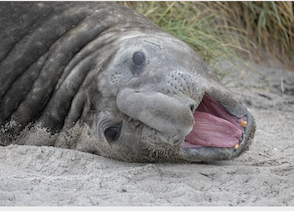
Elephant Seals, specifically the Southern Elephant Seals have the main breeding colony on Sea Lion Island. Breeding activity peaks in December and January and their population has declined due to commercial fishing that impacts their food courses. They are extremely large and can weigh up to 8,800 lbs. They are not friendly to humans and due to their large size, sharp teeth and the swiftness on land, it is advisable to keep at least 50-100 feet away and not disturb them.
Sea Lions are found throughout the islands. Sea Lion Island is a major breeding site for the Southern Sea Lion, where the males gather harems during the breeding season. They prefer sheltered beaches on tussac islands and the breeding season is December to February, with January being a peak time for seeing their breeding behavior.
~ ~ ~ ~ ~
To see more of Leigh Lofgren's photos or to order copies, visit https://www.leighlofgren.com/
This story appeared in Lakelife magazine, Volume 19, Issue 6 and is the property of Smith Communications, Inc. No portions of the story or photos may be copied or used without written consent from the publisher.


Comments