


Every cat’s best friend
Updated: Jan 29
Story by Lynn Hobbs, photos contributed

There will be no cool cats in Melanie Robertson’s world. At least she’s doing everything possible to prevent them.
Melanie isn’t concerned about easygoing jazz musicians or confident, stylish individuals. Instead, she’s worried about literal felines who are left out in the cold day in and day out.
When she learned the importance of community cats being sheltered from the elements, Melanie researched online and learned how to make cat shelters out of Styrofoam coolers. Through volunteer work with the Morgan County Humane Society, Melanie was acquainted with the high number of outdoor cats on her road and elsewhere in Madison, so she knew she’d need a lot of foam coolers.
“But they’re expensive to buy outright,” she said. A search online sent her to a bakery in Loganville where she purchased large Styrofoam coolers that frozen cakes had been delivered in. The coolers cost her $5 each, and their sides were thicker than regular coolers.

She brought the coolers home, lined them with Reflectix insulation, added a cushion of wheat straw inside, and used her drill to cut a hole in the front for an entrance. “And then I taped the lid on and—voila!--I had an animal shelter,” she beamed.
Melanie gave the shelters to various people in the community that she knew were feeding outdoor cats. She explained that wheat straw is better than blankets or hay, because wheat straw does not retain moisture or get moldy. It cost her about $20 to make each shelter.
When she ran out of supplies, Melanie turned to a Morgan County social media page and asked if anyone had any foam coolers laying around.
“A lot of people responded—one even said they found a cooler at the dumpster and I said ‘I’ll take it!’ But most of them are the coolers that Omaha Steaks come in,” she said. “They’re a little bit smaller than the frozen cake ones, but they have thick sides, too.”
She used those to create more shelters, which she gave to Morgan County Animal Services “because they have a lot of cats outside over there,” she said.
Melanie delivered several other cat shelters to other people in the community, but said if she could "teach people to do it, then they can make their own and that’ll be even better.” She recommends putting something heavy on top of the shelter to keep it from blowing away.

“Sometimes, the cats are wary to go inside of them, so I spray a little bit of catnip inside to get them to go in it,” she added.
It’s not a good idea to put food inside them, because food can attract predators to where the cats are sleeping and wouldn’t be safe for them, Melanie explained.
“And sometimes you can get non-feline occupants in your shelter,” she noted. “I’ve had a couple of opossums take up residence in two of them, but they need a place, too!” she laughed. “And they don’t contribute anymore to the household income than the cats, so why not?!”
All total, Melanie has made 30 shelters and has put out a request for people to let her know if they come across more coolers, which she’ll collect and continue to make shelters throughout the year. When questioned, she said the wheat straw would need to be changed at the beginning of next winter.

For those not familiar with feline terminology, Melanie explained that pet cats are ones that live indoors while also routinely going outside; they are accustomed to people and being handled by people. Stray cats had a home at one time but became lost or abandoned and no longer have a home. Feral cats have never been socialized, are fearful of people and avoid people. Community cats are both strays and ferals living in groups outdoors. People who feed them and water them are called colony caretakers.
“Some people say ‘they’re not my cats,’ but if you put food and water out for them, they become your cats,” Melanie said.
From her experiences at the humane society, Melanie described that many lower income, elderly, or lonely people see an abandoned cat and compassionately put out some food for it.
“You feed one cat and it becomes two,” she said. “Before long, two cats become four, and four become six, and then they find themselves feeding 12 cats. They’re so focused on trying to afford feeding all those cats, they can’t even think about trying to get them fixed or vaccinated.”
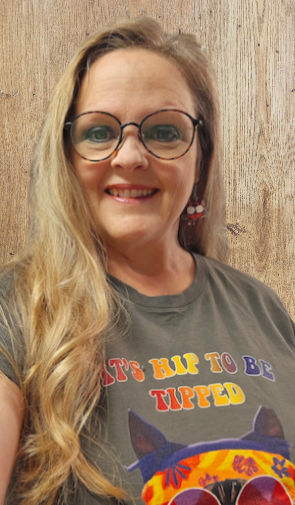
Melanie speaks freely because she’s been there herself. She grew up around cats and always liked them, but never realized there was a responsibility that if you’re feeding them, you’ve also got to have them spayed/neutered.
“There’s a lot of judgement in the rescue world, but we’re all just trying to figure it out,” Melanie said. “I was there, too. I didn’t know there are ways to take care of them. But now that we know better, we can do better for them.”
Melanie is more than just a proponent of taking care of community felines. When she isn’t working at her job as a home healthcare nurse, Melanie is busy educating people on an individual basis and in groups; acclimating and socializing community cats to ready them for adoption; trapping, neutering, vaccinating and returning them; and getting medical care for them if needed.
“If you put food out early and catch them early, at about 10 weeks, then they can be tamed and socialized and then they can be put up for adoption,” she said. “That’s a good situation; we’ve done quite a bit of that.”
Melanie’s passion for and patience with community cats seems to know no bounds. She regularly visits the colonies where she placed shelters to make sure the cats are doing okay. She spent five months sitting outside daily while a cat named “Buster” ate from a bowl of food nearby in order to acclimate him. Buster had been living outside the humane society for 13 years when a dog down the street attacked him, requiring Buster to have surgery. After the surgery, Buster still couldn’t handle being inside. So Melanie and her husband adopted him, but Buster didn’t acclimate too well to being outside of their house either.
“He’s chunky, so he’s food motivated,” she chuckled. “So I’d put food out and sat with him

for five months while he ate. Then he started coming inside. And now, he sleeps with us. He’s still a little skittish, but I told him it’s about time he discovered a real bed,” she added with adoration.
In addition to Buster, an 18-year-old cat named Lucy lives at the Robertson household, both of them venture outside but sleep inside. She also adopted three kittens that were what she calls “foster fails.” “I’ve bonded with them, so we’re not adopting them out,” she added.
Melanie also has a feeding station outside of her fence that is regularly visited by eight or nine cats that at one time frequented her neighbor’s house. She said all of those have been trapped, neutered, vaccinated and returned.
“They’ve all been fixed, so they’re calm,” she described. “They’re not fighting over the food and they’re not fearful. They can go chase leaves in the yard like a kitten would do, because they’re not worried about the things they worried about before.”
Essentially, it sounds like they’re cool cats.
To find out about low-cost or free neuter/spay services, vaccinations, or pet healthcare, contact your local humane society or county animal shelter. Also contact them if you want to help or volunteer with homeless animals. To contact Melanie regarding cat shelters or the TNR program, call the Humane Society of Morgan County at 706-343-9977.
~ ~ ~ ~ ~
This story appeared in Lakelife magazine, Volume 20, Issue 1 and is the property of Smith Communications, inc. No portions of the story or photos may be copied or used without written consent from the publisher.


Comments